

By Farooq Kperogi

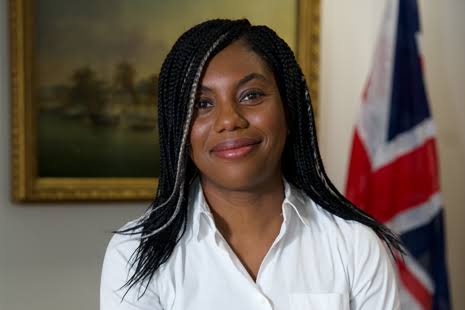
KEMI Badenoch, current leader of the UK’s Conservative Party, recently disavowed her Nigerian identity because of her resentment at being associated with northern Nigeria. “Being Yoruba is my true identity,” she said, “and I refuse to be lumped with northern people of Nigeria, who ‘were our ethnic enemies,’ all in the name of being called Nigerian.”
I can bet my bottom dollar that most northern Nigerians are uninterested in any claim to kinship with her, either.
Well, since Ms. Badenoch hates northern Nigeria that much, she might also consider rejecting even the term Yoruba, as it originates from—of all places—northern Nigeria!
“Yoruba” is, after all, an exonym first bestowed upon the Oyo people by their northern neighbors, the Baatonu (Bariba) of Borgu, before it was shared with the Songhai (whose scholar by the name of Ahmad Baba has the distinction of being the first person to mention the name in printas “Yariba” in his 1613 essay titled “Al-kashf wa-l-bayān li-aṣnāfmajlūb al-Sūdān”).
Usman Dan Fodio’s son, Muhammad Bello, wrote Infaq al-Mansur in 1813, which responded to Ahmad Baba’s 1613 essay. In it, he had cause to also mention “Yariba.”
The name’s embrace as a collective identifier owes debts to these historical facts. In other words, Yoruba is not a Yoruba word. It traces etymological descent from northern Nigerians, Badenoch’s “ethnic enemies.”
Perhaps Badenoch would prefer to invent an ethnic moniker akin to Professor Wole Soyinka’s deftly coined Ijegba (a seamless blend of Ijebu and Egba identities). She might consider Ijendo, an elegant portmanteau uniting her maternal Ijebu roots with her paternal Ondo lineage.
It would, at least, shield her from the burden of bearing an identity whose label comes from her “enemies.”
Yet even with this rhetorical sleight of hand, Badenoch cannot outrun the stubborn truth that the historical, cultural, and sociolinguistic ties between northern Nigerians and Yoruba people are irrefutable. These connections run deep and are impervious to political grandstanding or identity cherry-picking.
In a column I wrote on October 9, 2021, titled “Arewa and Oduduwa: More Alike Than Unlike,” I explored this shared legacy. I reproduce some of that original column below as a reminder.
Centuries before colonialism and the British-supervised formation of Nigeria, much of what we know today as northern and western Nigeria have had robust relational and cultural encounters, evidence of which still endures in the contemporary linguistic and cultural artifacts of the people.
READ ALSO: A reflection on Daily Trust’s tension with Tinubu, by Farooq Kperogi
The centuries-long Trans-Saharan Trade between the Arab world and so-called Sub-Saharan Africa, which passed through much of what is now northern and western Nigeria between the eighth and the seventeenth centuries, brought traces of Islam and cultural interchanges in both places.
Thereafter, both regions witnessed massive migrations of the Mande people from the Mali empire who brought more concentrated expressions of Islam—and monarchies. That is why much of what used to be the Oyo empire was actually ethnically syncretic.
Historians have shown that people that are today known as northern Nigerians played central roles in pre-colonial Yoruba history. For example, the Bashorun (whom many people equate to the Prime Minister and de facto power behind the throne) was often of Borgu descent, and the Alapinni, another high-ranking official, traced his origins to the Nupe people.
Well-regarded bashoruns like Magaji, Worudua, Biri, Yamba, Jambu, and Gaa who helped extend Oyo’s frontiers were of Borgu origin.
More than that, several towns and villages in Oyo were founded by Borgu people. For instance, Ogbomoso, a major Oyo town, was founded by a Baatonu (Bariba) prince. The title of the town’s monarch, “Soun,” is a corruption of “Suno,” the Baatonu word for king.
Yoruba sometimes swallows middle consonants over time, which explains why “olorun” sometimes becomes “olo’un,” why even “Yoruba” (itself a foreign word derived from the Baatonu) becomes “Yo’oba” in everyday speech, etc. On this model, the “n” in “suno” was swallowed to produce “suon,” which later became “soun” after the transposition of the “o” and “u” vowels in the word.
Kishi, another major town in Oyo State, was founded by a Borgu prince by the name of Kilishi Yeruma. Kilishi is the Hausa word for rug (which symbolises the throne) and Yeruma is the corruption of the Kanuri “yerima,” which means prince. But “Kilishi Yeruma” is a fossilized, time-honored title in all of Borgu, which is a cultural melting pot, for the heir apparent to the throne.
In fact, I was shocked to read recently that even Ibadan, the administrative capital of Western Nigeria, was founded by a northern Nigerian of Borgu origins. Oluyole, the founder of modern Ibadan, was the scion of Bashorun Yau Yamba, who was of Borgu ancestry.
In fact, the town of Igboho whose son, Sunday Igboho, has become the symbol of “Oduduwa nation”and who has thrown his weight behind Badenouch’s claim of being Yoruba who has no connection to northern Nigeria, is ethnically syncretic.
Apart from the large number of Fulani people in and around the town who have lived there for centuries, some of whom have become culturally and linguistically Yoruba, there is a major neighborhood there called Boni.Boni is the generic Borgu birth-order name for the fourth son.
Historical accounts also reveal that during the Trans-Saharan Trade, many Hausa people worked as intermediaries between Arab traders and the Alaafin of Oyo. Most didn’t return to their places of birth, and their descendants are now Yoruba people.
Similarly, we read from the late Professor Abdullahi Smith’s account of the tiff between Afonja and the Alaafin of Oyo that a large chunk of Afonja’s army, called the Jama’a, was drawn from Hausa slaves who escaped from the Alaafin’s palace.
And the Fulani presence in Yoruba land preceded the coming of Mu’alim “Alimi” Salihu to Ilorin by several decades, perhaps centuries. As I pointed out in a past column titled “Ilorin is an Ethnogenesis: Response to Kawu’s Anti-Saraki Ilorin Purism,” some of Afonja’s followers, with whom he fought the Alaafin, according to Abdullahi Smith who quoted the Ta’alif, a pamphlet written in Arabic by an Ilorin Yoruba Muslim cleric about the events of the time shortly after they occurred, were Fulani pastoralists who were never Muslims.
The pastoralists had lost their cattle to tsetse fly bites and “had nothing to lose,” according to Smith, so they became Afonja’s mercenaries.
One of the Fulani pastoralists whom Alimi couldn’t convert to Islam was a man named Ibrahim Olufade who spoke perfect Yoruba and Fulfulde and acted as the interpreter for Afonja in his initial interactions with Alimi.
In other words, Fulani people had been bearing Yoruba names in Yorubaland at least a century before Nigeria was formed. I won’t be surprised if descendants of Ibrahim Olufade are now Yoruba (nationalists)—if they are in western Nigeria.
My hunch has some basis in real-life examples. One of northern Nigeria’s most celebrated journalists, the late Hajia Bilikisu Yusuf, was descended from Yoruba people who migrated to Kano generations ago. She was one of the most passionate defenders of Arewa that I know.
When the late Mohammed Sule, author of the famous The Undesirable Element in the Pacesetter Series, told me of Hajia Bilikisu’s Yoruba background in Kaduna in the late 1990s, I was incredulous. But he said they were neighbors in Kano and swore that Hajia Bilikisu’s grandfather still spoke Yoruba.
The ancestors of the late Professor Ibrahim Ayagi of Kano were Yoruba. As he himself told the DailyTrust on September 2, 2018, “Unguwar Ayagi was initially inhabited by the Yoruba and Nupawa, who came from outside and settled here. That’s how the place became known as Ayagi. So most of the people in Ayagi are Yoruba, Nupe and, of course, Hausa.”
Given this depth and breadth of relational interconnectedness, it is no surprise that northern and western Nigeria share an extensive repertoire of cultural vocabularies that are derived from Arabic, Songhai (because the Malians who brought Islam to Hausa land, Borgu, and Yorubaland abandoned their language and spoke a dialect of Songhai called Dendi), and mutual borrowings.
I will give a few examples. In both Yoruba land and Borgu, the term from an unmarried girl is some version of the word “wondia.” That’s a Songhai word for an unmarried girl.
“Bere,” a title of respect prefixed to the names of older people in Borgu and parts of Yoruba land, is a Songhai word. The word “karambani,” which I was shocked to find out occurs in Yoruba, is a Songhai word that is now integral to the lexis of many languages in Borgu.
READ ALSO:
- Orban wins September GOTM award in Turkey
- Suspected bandit arrested with stolen goat
- After quarrel, man allegedly hacks father to death with machete
- NAHCON raises Nigeria’s 2027 Hajj quota to 60,000
- Trump fumes, threatens Iran with ‘very hard’ strike over flydubai attack
Asiri, the word for secret in Hausa, Yoruba, Kanuri, Baatonu, and many other languages in Muslim northern Nigeria, is derived from the Arabic “as-sirr” where it also means “secret.”
Wahala, which used to be limited to Yoruba and languages in Muslim northern Nigeria, but which is now widely used all over Nigeria, is derived from the Arabic “wahla,” which means “fright,” “terror.”
Yoruba and most languages in Muslim northern Nigeria also use “talaka” (talika in Yoruba) to refer to the poor. The word also appears in Mandinka, Songhai languages, Teda, and in other West African polities where Islam is predominant.
History is rarely as malleable as we would like, and identity, once examined, often reveals far more connection than division.
If Badenoch truly fancies herself as Yoruba, she’d be wise not to rattle the ancestral tree; she might be startled by just how much Northern Nigeria comes tumbling out of its branches.
