

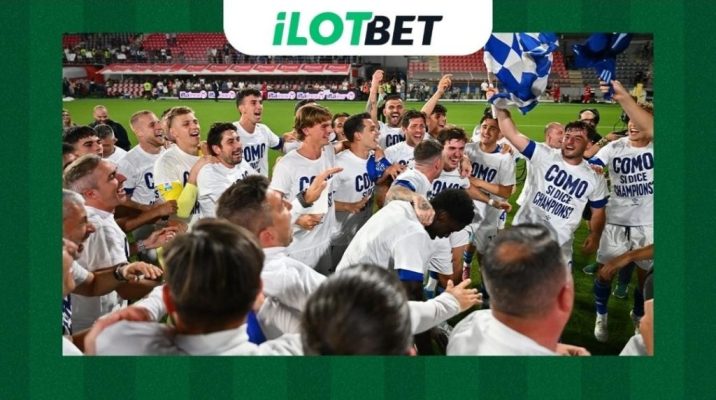
There was a time when Italian football set the standard for the rest of Europe. Serie A was where tactical innovation lived, where the world’s best defenders played, where the Champions League often felt like an extension of domestic competition. From Arrigo Sacchi to Marcello Lippi, from Fabio Capello to Carlo Ancelotti, Italy produced ideas as consistently as it produced trophies.

Now, it produces nostalgia.
That is why Como’s astonishing qualification for the Champions League matters far beyond one club’s remarkable rise. In a season that exposed almost every structural weakness within Italian football, Como have emerged as the lone convincing argument that Serie A still has a future worth believing in.
The wider picture is grim. Juventus FC and AC Milan both failed to qualify for the Champions League for the first time in the modern era, an outcome that would once have been unimaginable. Italian clubs, meanwhile, have struggled to compete consistently in Europe again after a brief revival two years ago. The league that once dictated the tactical evolution of football increasingly looks unable to keep pace with the speed, intensity and athleticism of the modern game.
And perhaps the clearest symptom of the stagnation is found on the touchline.
Italian football has become trapped in a cycle of managerial recycling, the same names, the same ideas, the same conservative instincts. Massimiliano Allegri returning to AC Milan before being dismissed again was merely the latest example of what Italians themselves call minestra riscaldata, reheated soup. Antonio Conte’s departure from Napoli after another short-term spell only reinforces the pattern.
Where is the next great Italian innovator?
For all of Italy’s rich coaching heritage, the league has struggled to produce a genuinely transformative young Italian manager capable of influencing European football in the way Mikel Arteta, Xabi Alonso or Julian Nagelsmann have elsewhere. Gian Piero Gasperini remains one of the few genuinely progressive tactical thinkers in Serie A, but even his success with Atalanta now feels more like an exception than evidence of a broader movement.
Too often, Serie A still defaults to caution. Defensive structure remains sophisticated, but modern elite football increasingly rewards verticality, pressing intensity, positional fluidity and athletic aggression. Italian teams frequently appear overwhelmed when confronted with the relentless tempo of Europe’s strongest sides.
Then there is Como.
Their rise from bankruptcy and Serie D football to the Champions League within seven years is extraordinary enough on its own. But what makes the story truly significant is how they have done it.
Under Cesc Fàbregas, Como have embraced a model that feels far more aligned with modern European football than much of the Italian establishment. Their recruitment has been young, technical and internationally minded. Their football has been proactive rather than reactive. They play with possession, bravery and tactical flexibility instead of fear.
Most importantly, they look forward rather than backward.
Fàbregas himself symbolises that shift. Educated in the positional systems of FC Barcelona and refined in the intensity of the Premier League, he represents a new-school managerial generation shaped by global football rather than purely domestic traditions. His Como side presses high, manipulates space intelligently and trusts technical players to solve problems, principles that increasingly define successful teams across Europe.
In many ways, Como’s success is an indictment of the rest of Serie A.
A newly promoted club with modern ideas, strategic recruitment and ambitious ownership should not be overtaking historic giants so quickly. Yet they have, because too many traditional powers remain paralysed by short-term thinking, financial instability and tactical conservatism.
Italian football’s broader problems are well documented: declining television revenues, outdated stadiums, governance issues and worsening financial imbalance. The national team’s ongoing crisis only deepens the concern, with Italy staring at another World Cup absence after already missing the last two tournaments.
Yet football cultures do not revive through nostalgia. They revive through reinvention.
That is why Como feels important. Not because they have reached the Champions League, but because they have reached it while embodying many of the ideas Italian football has resisted for too long.
Serie A still has a magnificent history. What it lacks is enough clubs willing to behave like the future matters more than the past.
For now, Como stands almost alone in understanding that.
READ ALSO:
- Okoya’s Son Idris Ties the Knot in Private Ceremony
- Lagos to host African Neurodiversity Conference as experts push for action beyond awareness
- EHA Impact Ventures Invests $50,000 in Ma’Zaine Foods to Scale Locally Produced Nutrition Solutions in Kebbi State
- Iheanacho extends scoring streak as Bursaspor beat Pendikspor
- NDLEA arrests 85-year-old grandmother with 179kg cannabis
