


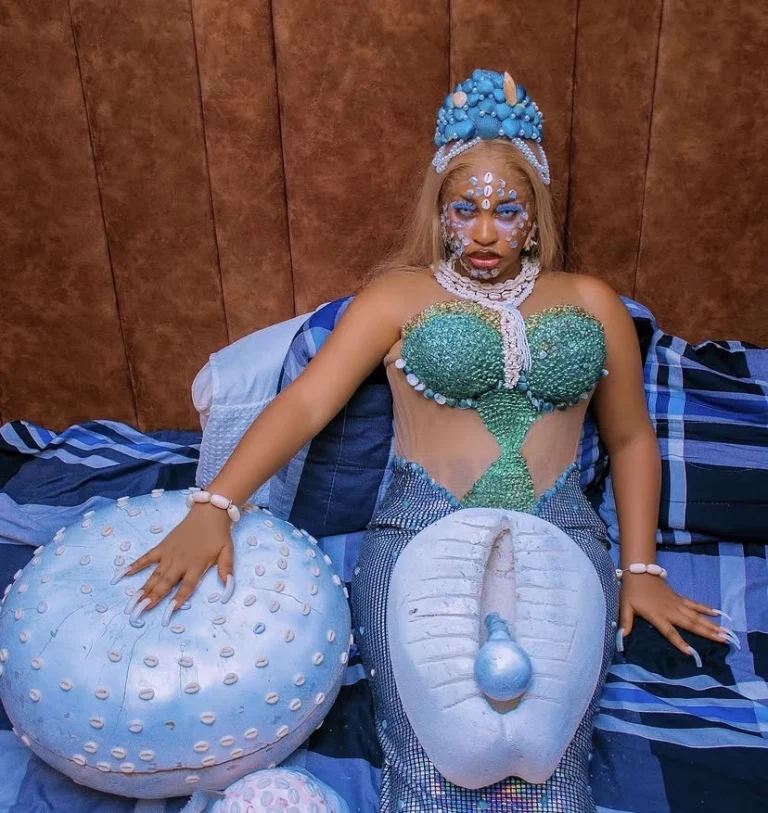

Nollywood actress and filmmaker Yetunde Barnabas has come under criticism from a Yoruba traditional worship custodian over the portrayal of indigenous deities in her upcoming movie, Olokun Mermaid.

Abiola Rosanwo, who introduced herself as the Yeye Owonrin Ojose Isara Remo and a custodian of Yoruba Isese practice, accused the actress of presenting sacred figures in ways she believes misrepresent Yoruba tradition.
Sharing her concerns in multiple Facebook posts on Saturday, Rosanwo argued that neither Yemoja nor Olokun should be depicted as mermaids or associated with fish imagery.
Prompt News reports Barnabas had earlier explained on Instagram that the project was first produced under the title Yemoja but was renamed after discovering that other productions online were already using that title alongside her image.
Reacting to the explanation, Rosanwo questioned the logic behind the change.
“If the name of your movie was Ogun, can you change the name to Sango after production? Yemoja is not Olokun. Olokun is not a mermaid. Yemoja also is not a mermaid or a fish,” she wrote.
She maintained that Yemoja, Osun and Olokun are separate deities within Yoruba spirituality and should not be merged or portrayed interchangeably.
“Across Yoruba land, Isese is one. No one has a record of Yemoja as a fish or mermaid. Osun, Yemoja and Olokun are not the same.”
The traditionalist also criticised recurring portrayals of Yoruba spiritual figures as Mammy Water characters, describing such depictions as inaccurate.
According to her: “Our Irúnmọlẹ̀ are not mythical half-human, half-fish creatures. They are sacred divine beings. Those who later became Òrìṣà walked the earth as complete human beings before their transition. To replace that heritage with foreign imagery is to misinform the public and dishonour our cultural and spiritual legacy.”
READ ALSO:
- Tinubu appoints Special Adviser on National Assembly – Reps
- WAFCON 2026: Algeria cruise past Senegal to win tournament opener
- Adeleke, Accord Party stakeholders endorse Tinubu for 2027
- Polytechnic suspends six lecturers over sexual harassment, cultism
- How NDLEA arrested Lagos trader over cocaine hidden in food cartons bound for UK
Rosanwo disclosed that members of the Molokun sect in Ijebu and other Yoruba communities had submitted complaints to the National Film and Video Censors Board and the Theatre Arts and Motion Pictures Practitioners Association of Nigeria.
She appealed for a review of the movie before release, insisting the intervention was about preserving cultural authenticity rather than limiting artistic freedom.
“My concern was never directed at creativity or artistic expression. Rather, it stemmed from the responsibility we all share to protect the integrity of sacred indigenous traditions,” she said.
Rosanwo further argued that Olokun, according to Yoruba Isese belief, is recognised as “a revered male Irúnmọlẹ̀” and should not be represented as a mermaid.
She later revealed that officials of NFVCB and TAMPAN had responded and opened discussions around the concerns.
“I write this open letter with profound appreciation and sincere gratitude to the leadership of the National Film and Video Censors Board and the leadership of TAMPAN, Remo Zone Ogun State, for your prompt response and swift intervention,” she stated.
She added that she hopes the development encourages stronger collaboration between filmmakers and custodians of indigenous traditions whenever Yoruba spirituality is explored in films.
