

By Tony Obiechina Abuja

The African Export-Import Bank (AFREXIM Bank) has called on African countries to redouble their efforts towards industrialisation of the continent.
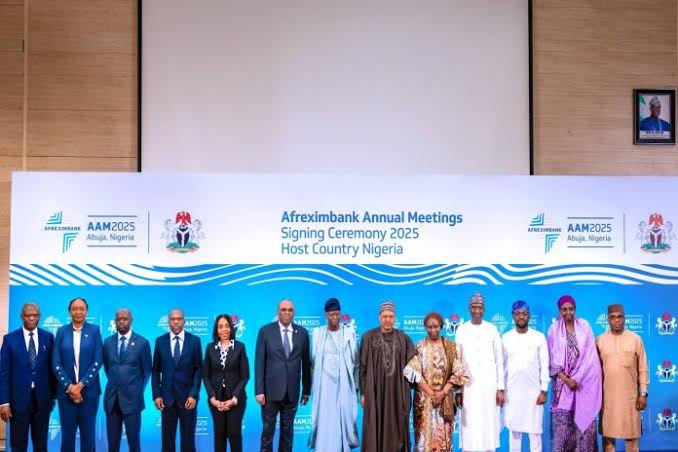
AFREXIM Bank’s Senior Executive, Denny’s Danya, made the call at the opening of the 32nd Africa Export-Import Bank Annual General Meeting in Abuja on Wednesday.
The AGM was declared open on behalf of President Bola Ahmed Tinubu by Vice President Senator Kashim Shettima who was represented by his Special Adviser on Economic Matters
Danya noted that Africa must be firm in its aspirations for industrialisation.
“In an era where there is scarcity of funding for African institutions, our homegrown institutions must be given all the support they require. We must focus on building strong, independent institutions, promoting good governance, and fostering regional cooperation. It is imperative to highlight that institutional strengthening also requires political support from our leaders, so as not to undermine our own institutions.”
He added that routine policies and reforms—including sound macroeconomic management, structural adjustments, and investments in key areas such as infrastructure and human capital—are crucial for fostering sustainable development across the continent.
He stated that for the continent to grow, efforts must be geared toward promoting value addition to Africa’s exports, as well as diversification of the continent’s export basket and export destinations.
“We must improve regional trade through the AfCFTA. We need to forge new trading partnerships and strategic alliances to leverage our collective strength and resources. Such partnerships and alliances will enhance access to new markets, offer competitive advantages, and boost innovation.”
He explained that in the face of economic uncertainties, there is the need to harmonise the continent’s strengths to shape a prosperous future.
“Africa is at a crossroads—a point where we need to be intentional about our aspirations, firm in our convictions, resolute in our actions, and determined in our collective purpose. We have reached a moment where we must unify our strengths, stand firm in our convictions, and confront our challenges head-on in shaping the future. I put it to us that strengthening African institutions—especially development finance institutions—is critical for sustainable development, democratic governance, and improved livelihoods.”
He maintained that it is imperative to build strong, independent institutions, promote good governance, and foster regional cooperation in order to build a resilient Africa.
The Governor of the Central Bank of Nigeria, Olayemi Cardoso on his goodwill message disclosed that
Nigeria got over $52 billion from Afreximbank for trade financing Projects.
According to him this makes Nigeria the Bank’s single largest beneficiary since inception in 1993.
Speaking under the theme, “Building the Future on Decades of Resilience,” Cardoso commended the bank’s transformation from a modest institution to a major force in Africa’s development finance landscape.
He noted that Afreximbank’s capital base had grown from $750m at inception in 1993 to over $40bn by the end of 2023.
He added that routine policies and reforms—including sound macroeconomic management, structural adjustments, and investments in key areas such as infrastructure and human capital—are crucial for fostering sustainable development across the continent.
He stated that for the continent to grow, efforts must be geared toward promoting value addition to Africa’s exports, as well as diversification of the continent’s export basket and export destinations.
“We must improve regional trade through the AfCFTA. We need to forge new trading partnerships and strategic alliances to leverage our collective strength and resources. Such partnerships and alliances will enhance access to new markets, offer competitive advantages, and boost innovation.”
He explained that in the face of economic uncertainties, there is a need to harmonise the continent’s strengths to shape a prosperous future.
“Africa is at a crossroads—a point where we need to be intentional about our aspirations, firm in our convictions, resolute in our actions, and determined in our collective purpose. We have reached a moment where we must unify our strengths, stand firm in our convictions, and confront our challenges head-on in shaping the future.
” I put it to us that strengthening African institutions—especially development finance institutions—is critical for sustainable development, democratic governance, and improved livelihoods.”
He maintained that it is imperative to build strong, independent institutions, promote good governance, and foster regional cooperation in order to build a resilient Africa.
The CBN governor called on African leaders, financial institutions, and the diaspora to pursue a development model that is “African-led and African-owned”, especially in the face of rising global uncertainties.
“Resilience is not accidental. It is engineered,” Cardoso said, urging the continent to invest in strong institutions, robust systems, and long-term thinking.
Cardoso also used the platform to outline recent efforts by Nigeria to stabilize its financial system and currency. He pointed to new diaspora-friendly policies such as the Non-Resident Nigerian Ordinary Account (NRNOA) and the Non-Resident Nigerian Investment Account (NRNIA) as ways to harness the economic power of Nigerians abroad.
“These initiatives aim to boost remittances and attract investments into critical sectors of the economy,” he explained.
Cardoso hailed Afreximbank for redefining the role of the African diaspora to include Afro-descendants in the Caribbean and the Americas, describing the bank’s approach as both inclusive and visionary.
He stressed the importance of coordinated engagement between African governments and diaspora communities to accelerate growth and investment across the continent.
Amid global economic fragmentation, Cardoso warned that Africa must reduce dependence on external actors and instead deepen intra-African trade, regional integration, and homegrown innovation.
“Rising trade protectionism and shifting geopolitical dynamics are undermining Africa’s development prospects,” he warned.
He also commended the outgoing Afreximbank President Prof. Benedict Oramah for his leadership, citing landmark achievements such as the Africa Medical Centre of Excellence in Abuja, developed in partnership with King’s College London.
“It is not many that have the fortune of making big dreams come true… Professor Oramah, I salute you,” Cardoso added.
In closing, the CBN governor called on African leaders to combine vision with execution, noting that only a few manage to do both effectively.
The African Export-Import Bank (AFREXIM Bank) has called on African countries to take deliberate actions toward industrialisation.
AFREXIM Bank’s Senior Executive, Denny’s Danya, made the call at the opening of the 32nd Africa Export-Import Bank Annual General Meeting in Abuja.
Danya posited that Africa must be firm in its aspirations for industrialisation.
“In an era where there is scarcity of funding for African institutions, our homegrown institutions must be given all the support they require. We must focus on building strong, independent institutions, promoting good governance, and fostering regional cooperation. It is imperative to highlight that institutional strengthening also requires political support from our leaders, so as not to undermine our own institutions.”
READ ALSO:
- 2026 FIFA U-17 Women’s World Cup: Flamingos Jersey Numbers Out
- 2026 FIFA U-17 Women’s World Cup: Flamingos Take On Poland Saturday
- WAFU B U-17 Tourney: Golden Eaglets determined to bounce back against Côte d’Ivoire – Eboboritse
- Opposition by Name, APC by Conduct: The Wike, Adeleke and Soludo Question
- Wicked Governance: The Bane of Struggling Nations, By Dr. Wole Akinwumi
He added that routine policies and reforms—including sound macroeconomic management, structural adjustments, and investments in key areas such as infrastructure and human capital—are crucial for fostering sustainable development across the continent.
He stated that for the continent to grow, efforts must be geared toward promoting value addition to Africa’s exports, as well as diversification of the continent’s export basket and export destinations.
“We must improve regional trade through the AfCFTA. We need to forge new trading partnerships and strategic alliances to leverage our collective strength and resources. Such partnerships and alliances will enhance access to new markets, offer competitive advantages, and boost innovation.”
He explained that in the face of economic uncertainties, there is a need to harmonise the continent’s strengths to shape a prosperous future.
“Africa is at a crossroads—a point where we need to be intentional about our aspirations, firm in our convictions, resolute in our actions, and determined in our collective purpose. We have reached a moment where we must unify our strengths, stand firm in our convictions, and confront our challenges head-on in shaping the future. I put it to us that strengthening African institutions—especially development finance institutions—is critical for sustainable development, democratic governance, and improved livelihoods.”
He maintained that it is imperative to build strong, independent institutions, promote good governance, and foster regional cooperation in order to build a resilient Africa.
Many times, leaders have one but not the other. In some environments, they have neither. That’s a huge challenge,” he said.
