

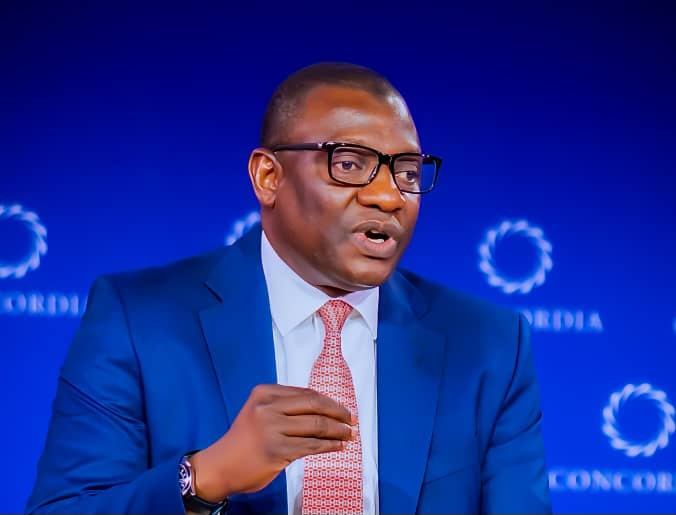
Bala Wunti, Chief Executive Officer of the World Energy Council Nigeria, has explained how the United States’ $110 per kilogram price floor for some rare earth products could help move Nigeria’s critical minerals sector from mineral potential to bankable investment opportunities.

Wunti spoke at the 2026 Concordia Annual Summit in New York during a panel titled, “Rare Currency: Critical Minerals in a Shifting Global Economy.”
The summit was held at the Sheraton New York Times Square alongside the United Nations General Assembly.
The panel examined America’s growing dependence on imported critical minerals, China’s dominance of global processing capacity, and the implications for defence, electricity, grid transmission and technology.
Wunti, a former Chief Upstream Investment Officer at the Nigerian National Petroleum Company Limited, has more than three decades of experience in developing and financing large-scale energy projects.
Nigeria has identified 44 commercially viable minerals, but the sector has yet to generate substantial economic value or attract investment on the scale recorded in the oil and gas industry.
Wunti said the central challenge was the gap between the presence of minerals and the availability of investable projects.
Having minerals in the ground is only the beginning, he said.
We had geological indications, but not reserves supported by JORC-compliant data. This meant that we knew minerals were present, but investors did not have sufficient information to finance their development.
Wunti said Nigeria also had mining policies without clearly defined projects capable of attracting investors.
United States investors invest in projects, not potential, he said.
According to him, six conditions are required to mobilise capital for mineral development: reliable geological data, clearly defined projects, enabling infrastructure, predictable regulation, credible developers and viable routes to market.
For 50 years, Nigeria exported crude oil and imported refined petroleum products. That created poverty, not prosperity, he said.
Wunti said the establishment of the Nigerian Solid Minerals Company would help convert Nigeria’s mineral potential into commercially viable projects.
He described the company as the country’s flagship investment platform and a credible counterparty for local and international investors.
The company is moving Nigeria from saying, “We have minerals,” to presenting clearly defined and investable projects, he said.
Rare earth elements are not necessarily rare in the ground. They are rare in the market. Bringing them to market requires capital and technology.
Wunti said Nigeria must present investors with commercially structured transactions rather than promotional documents.
We must move from potential to bankability. Investors need an actual transaction, not merely a presentation, he said.
Four conditions for private capital
Wunti identified four key requirements for attracting private capital into Nigeria’s critical minerals sector.
The first is geological data that meets JORC standards, rather than the mere identification of mineral occurrences.
The second is a commercially viable price that gives investors confidence that projects can generate sustainable returns.
The third is a stable and competitive fiscal system, while the fourth is a credible buyer willing to enter into a long-term purchase agreement.
Private capital must do the heavy lifting, but government must make projects investable, Wunti said.
Government must address the risks investors cannot solve independently, including geological uncertainty, unpredictable regulation, inadequate infrastructure and inefficient permitting.
He, however, said government intervention could not permanently sustain an economically unviable project.
Government can make a project bankable, but it cannot permanently make an uneconomic project profitable, he said.
Why the $110/kg price floor matters
Wunti said the United States’ price floor of $110 per kilogram for neodymium and praseodymium products provides investors with a measure of revenue certainty.
A price floor guarantees that eligible products will not be purchased below an agreed amount, reducing investors’ exposure to sharp price declines and market volatility.
According to Wunti, this type of intervention can encourage lenders and private investors to finance mining and processing projects that might otherwise be considered too risky.
The lesson is price, not pitch. The $110 per kilogram floor helps close the gap between government policy and commercial reality, he said.
Give me a credible price, and I will give you private capital.
Wunti said the development of Africa’s critical minerals must go beyond extraction and include local processing, manufacturing and job creation.
We must move from barrels to kilograms and from extraction to processing. That is how Africa wins, he said.
READ ALSO:
- Organisers Announce New Date For 18th Headies
- I Underwent Five Surgeries In One Year While Trying To Conceive — Toyosi Adesanya
- EPL: Arsenal rally to beat Leeds United in thrilling Emirates comeback
- 2028 Olympics Qualifiers: Eguavoen applauds Super Falcons’ victory over Comoros
- Fear as kidnappers abduct teacher, two others in community
The 2026 Concordia Annual Summit is a nonpartisan global forum held alongside the United Nations General Assembly, bringing together leaders from government, business and civil society to address international challenges. Past speakers have included former US Presidents Joe Biden, George W. Bush and Bill Clinton, former British Prime Minister Tony Blair, UN Secretary-General António Guterres and business leader Warren Buffett.
